Applications Engineer · Wolfram MathCore · Linköping, Sweden

Physical modeling, simulation, and the overlap with machine learning.

I build and simulate multi-domain systems using Modelica and Wolfram Language. I write books and give conference talks to make these methods accessible to working engineers. At Wolfram MathCore, I work on AI-simulation hybrid workflows.

Get in touch

Ankit Anurag Naik

Selected work

Field note
Tracking crop growth from orbit—a digital twin of one Swedish wheat field

Part 1 of a five-part series on digital twins with System Modeler and Wolfram Language. One winter-wheat field west of Linköping: Sentinel-2 reads its greenness every few days, SMHI supplies the weather, a stock-and-flow model predicts the season, and a Wolfram Databin keeps the numbers where any browser can reach them. Calibrated on five past seasons, running live on the one underway, every source free and public—and the twin already disagrees with the satellite, for a reason the model can explain.

Read the field note → Open the live twin → Discuss on Wolfram Community →
Field note
A hundred years in the air—a century of flight, one simulation per era

The Swedish Air Force turned 100, so I flew the century in simulation: seven aircraft from one Modelica library, from a hands-off glider to a drone that flies its whole mission alone. Every era fixed the last one's limitation and bought a new one—the piston ran out of air at 9 000 m, the J 35-class delta reached 11 km in 7.2 minutes but burned 30% of its fuel doing it, and the battery brought back the glider's arithmetic. Simulated in System Modeler, animated in Blender.

Read the field note → Download PDF →
Field note
Can the transformer be smaller and safer?—simulating solid state power

The transformer on your street is a 140-year-old design: iron, copper and a tank of oil. I modeled a neighborhood in Modelica and threw the same short circuit at the old gear and its solid state replacement. The old breaker let 6 000 A run for a tenth of a second; the solid state transformer never passed 430 A. Simulated in System Modeler, rendered in Blender.

Read the field note → Download PDF →
Field note
Bowled by a late swinger—modeling how a cricket ball moves

Got out to a ball that pitched on middle and hit off stump, so I modeled it—multibody flight, an aerodynamic side force, and a contact model for the bounce. Length turned out not to change how much it swings at all: 0.38 m every time. What length changes is how long you get to read it—81 ms off a full ball, 324 ms off a short one.

Read the field note → Download PDF →
Essay
Modeling a book launch as a stock-and-flow system

Built a Modelica stock-and-flow model of reader acquisition—tracking seven stocks, six feedback loops, and a three-month simulation. The model showed the warm pool of aware-but-unconverted readers was 20× the buyer count. That changed what I did next.

Read on LinkedIn →
Talk
Training Your AI with System Modeler

Three workflows using simulation as the training environment: a neural state predictor for EV battery temperature, a CTESN surrogate model for fast optimization, and a Q-learning agent trained entirely inside simulation. All grounded in physics, all traceable to equations.

YouTube →
Talk
Rooftop solar ROI—a replicable simulation workflow

Thermal model of a house in Linköping using 10 years of PVGIS climate data. Full energy demand and PV production simulation. Payback period: 16 years in Sweden, 6 in Delhi, 3.6 in Calama, Chile. Template notebook available for any location.

YouTube →
Research
CTESN surrogate modeling for Modelica model calibration

Continuous-Time Echo State Networks trained on simulation data to replace expensive physics models inside calibration and optimization loops. Matches full-model dynamics, runs orders of magnitude faster, and exports as a native System Modeler component.

Wolfram Community →

Books

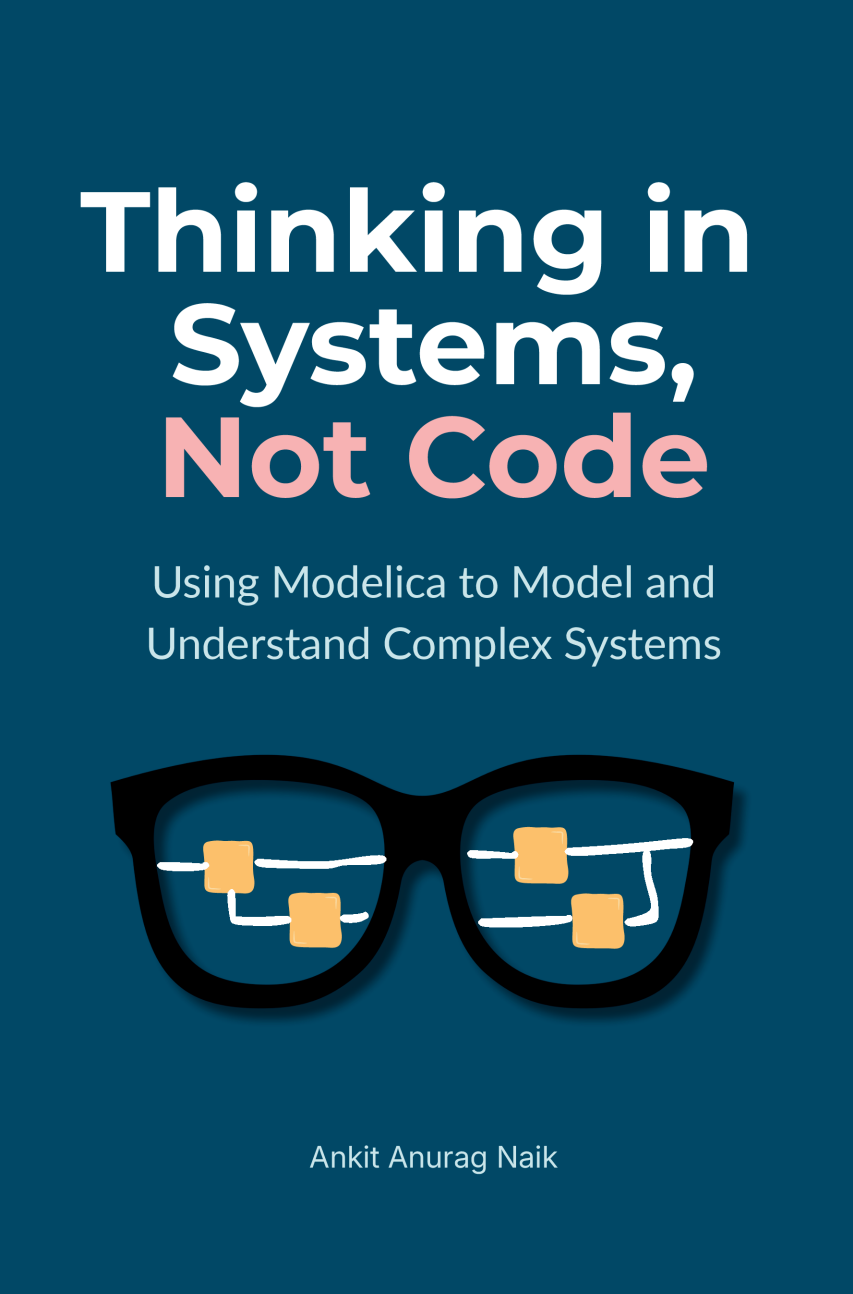
Thinking in Systems, Not Code
Modelica · Systems thinking
Thinking in Systems, Not Code

How to model complex systems—energy, control, business, physical—using Modelica as a reasoning tool. Written for engineers who want to understand system behavior, not just simulate it.

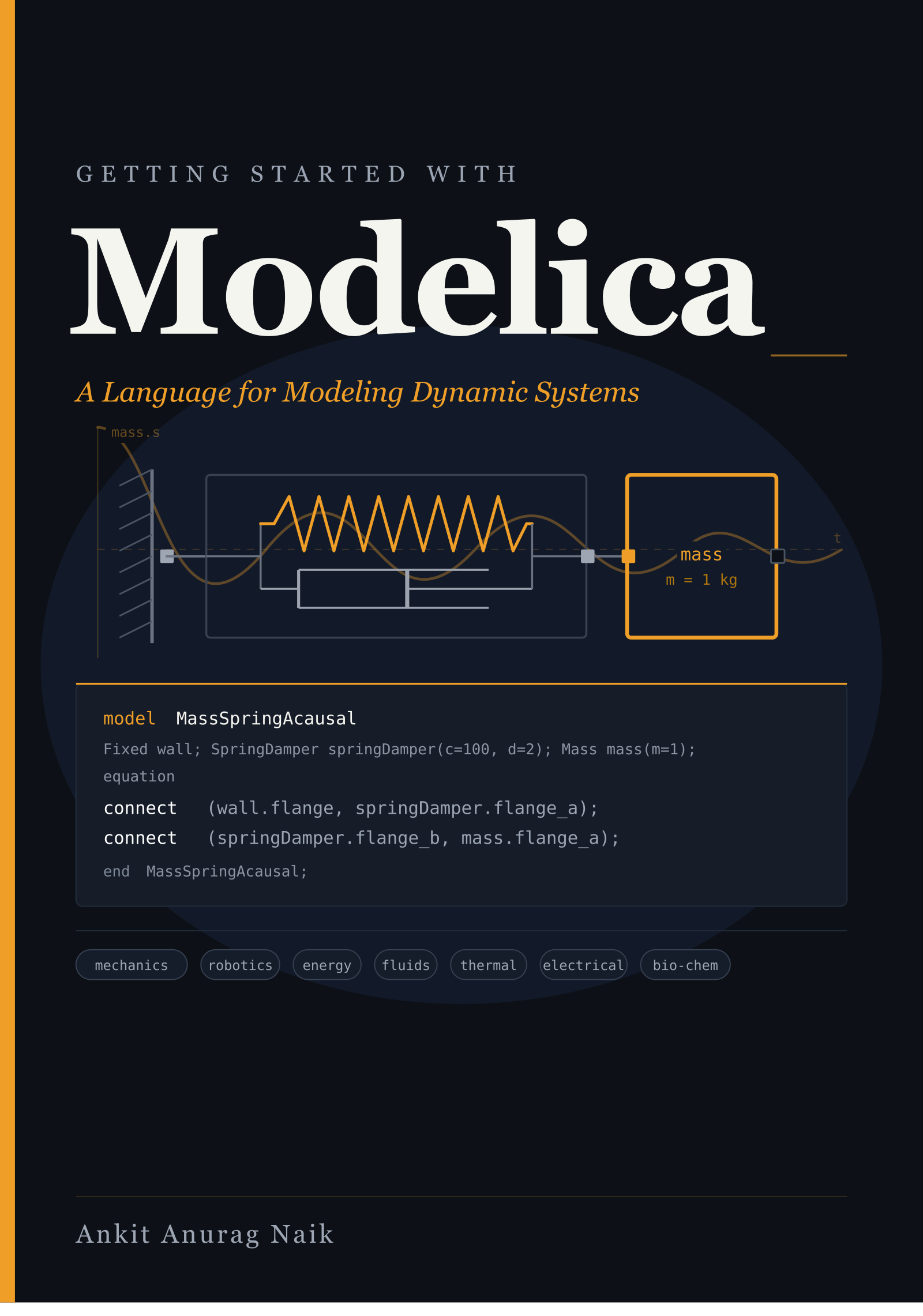
Getting Started with Modelica
Beginner · 2026
Getting Started with Modelica

A ground-up introduction to Modelica and Wolfram System Modeler, developed from a two-day workshop with aerospace engineers. Covers the language, multi-domain modeling, and practical simulation workflows from first principles.

"The material is very approachable and contains lots of great insights."

Michael Tiller—author of Modelica by Example, via LinkedIn


Community & talks

Wolfram Community

Public notebooks and tutorials

Worked examples on System Modeler, Wolfram Language, surrogate modeling, and AI-simulation workflows. All notebooks are public and free.

community.wolfram.com/web/ankitn →
Conference presentations
  • Train Your AI with System Modeler—Modelica Conference 2024
  • Thermal Management of EVs—Wolfram Technology Conference
  • Rooftop Solar ROI: simulation-based workflow for any location
  • CTESN surrogate modeling for Modelica model calibration

Applications Engineer at Wolfram MathCore in Linköping, Sweden. I work on multi-domain system modeling, simulation, and workflows that connect physics-based models to analysis, optimization, and machine learning.

Two books published. A third—Thinking in Optima, on engineering optimization with Modelica and Wolfram Language—is in progress.


Get in touch.

If you're working on something in this space—physical modeling, simulation, AI-physics integration—or just want to compare notes, feel free to reach out.